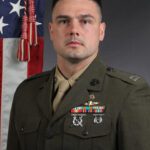

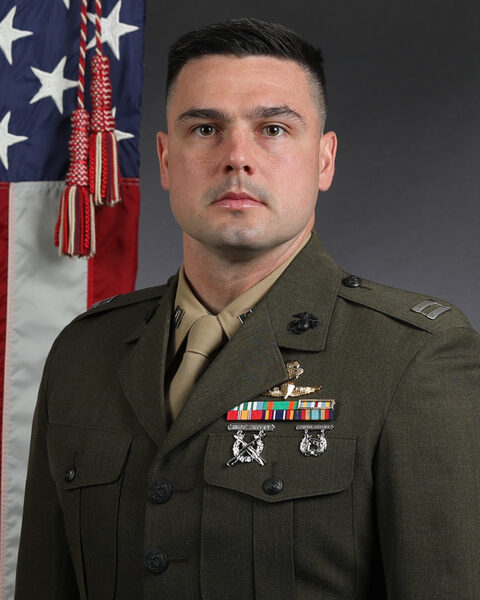
Capt Hayden Knudson
Intelligence OfficerCaptain Hayden Knudson serves as a student in
Conference Group 8 at Expeditionary Warfare School.
Captain Knudson is a native of Alexandria, VA who
graduated from The University of New Hampshire in 2016 with a
Bachelor of Science degree in Business Administration. He
completed Officer Candidate School and was commissioned in
March of 2018.
He graduated from The Basic School in 2018 and was
assigned the military occupational specialty (MOS) of 0203 -
Ground Intelligence Officer. Upon completion of MOS training, he
reported to 3d Marine Regiment in Kaneohe Bay, HI to serve as
the Regiment’s Targeting Officer. In 2020, Captain Knudson
executed Permanent Change of Assignment orders to serve as the
Sniper Platoon Commander, Weapons Company, 2d Battalion, 3d
Marines. During this assignment, he completed the Unit
Deployment Program to Okinawa, Japan.
In 2022, Captain Knudson attended the Basic
Reconnaissance Course to become a Reconnaissance Officer.
Following Graduation, he completed the reconnaissance pipeline
and executed orders to to 3d Reconnaissance Battalion, 3d Marine
Division in Okinawa, Japan. Upon his arrival, he assumed
command of 1st Platoon, Bravo Company and led his platoon on
back-to-back deployments to key terrain within the INDOPACOM
Area of Responsibility as members of the 24-2 and 25-2 Joint
Training Team rotations.
In 2024, Captain Knudson was selected on the
Commandments Career Level Education Board to attend
Expeditionary Warfare School during academic year 2026. In June
of 2025, he reported as a student to Expeditionary Warfare school,
Resident and is currently a student.
Captain Knudson's personal decorations include the Joint
Service Commendation Medal and the Navy and Marine Corps
Achievement Medal. Captain Knudson is currently enrolled as a
student at the University of Maryland – Global Campus, working
towards a master’s degree in Cybersecurity Technology.
A Hitchhiker’s Guide to RxR in the WEZ
In future conflict, the first casualty will not be maneuver forces, logistics nodes, or command posts; it will be certainty. As the character of warfa
…In future conflict, the first casualty will not be maneuver forces, logistics nodes, or command posts; it will be certainty. As the character of warfare shifts from counterinsurgency to competition with near-peer adversaries, the United States Marine
…In future conflict, the first casualty will not be maneuver forces, logistics nodes, or command posts; it will be certainty. As the character of warfare shifts from counterinsurgency to competition with near-peer adversaries, the United States Marine Corps faces an operational environment defined by degraded sensing, contested communications, and persistent adversary reconnaissance. Nowhere is this challenge more severe than for reconnaissance fo
…In future conflict, the first casualty will not be maneuver forces, logistics nodes, or command posts; it will be certainty. As the character of warfare shifts from counterinsurgency to competition with near-peer adversaries, the United States Marine Corps faces an operational environment defined by degraded sensing, contested communications, and persistent adversary reconnaissance. Nowhere is this challenge more severe than for reconnaissance forces operating as Stand-in Forces (SIF) inside a sophisticated anti-access/area denial (A2/AD) bubble. The Marine Corps Intelligence, Surveillance, and Reconnaissance Enterprise (MCISRE), long optimized for permissive environments and centralized intelligence architectures, must adapt to a battlespace where detection is constant and survivability fleeting. By examining the limitations of current ISR constructs, assessing adversary counter-reconnaissance capabilities, and drawing lessons from historical case studies such as the Yom Kippur War, we analyze how artificial intelligence (AI) and disruptive technologies are not merely force multipliers, but prerequisites for effective reconnaissance and counter-reconnaissance in competition-to-conflict scenarios. We argues that the MCISRE should leverage low-cost, unmanned, commercial-off-the-shelf (COTS) systems paired with AI-enabled autonomy to support distributed collections and tactical deception, regain the information advantage, persist within the weapons engagement zone (WEZ), and shape the battlespace in support of joint and naval operations.
Show MoreClick the title to see all detailsShow More