
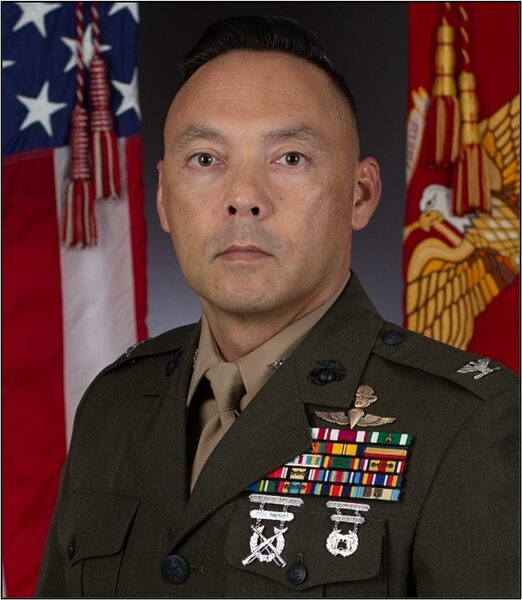
Col Ryan Murata
Director, Office of Marine Corps ReserveColonel Ryan S. Murata is currently serving as the Director, Office of Marine Corps Reserve.
He enlisted in the U.S. Marine Corps Reserves in 1992 as a reconnaissance man and finished his enlisted tenure as a reconnaissance platoon sergeant.
In 2000 he received his commission in the U.S. Marine Corps and was designated an infantry officer with follow-on designations as an expeditionary ground reconnaissance officer, foreign security force advisor, information operations officer, and FDP&E officer. He has deployed in support of operations as a commander or officer in charge to the USINDOPACOM AOR, Iraq, Afghanistan, Jordan, Royal Bahamas, and Mexico.
Staff assignments include Integration Cell Director, Eisenhower School for National Security and Resource Strategy; Operations Officer, Office of Marine Forces Reserve; Operations-Intelligence Coordination Officer, Regimental Combat Team One; Operations Officer, 4th Reconnaissance Battalion; and Mobilization and FDP&E Section head, PP&O.
Colonel Murata has a Bachelor of Science in Agricultural Development from Texas A&M University, a Master of Science in Management and Master of Business Administration from the University of Maryland Global Campus, and a Master of Science in National Resource Strategy from the Eisenhower School for National Security and Resource Strategy.
He is married to his wife Jennifer and has three children; Ryan, Evelyn, and Aiden.
The Unfair Advantage: Mobilizing Marine Corps Power
In an era of renewed great-power competition, the United States Marine Corps confronts the imperative to rapidly generate and sustain combat power on
…In an era of renewed great-power competition, the United States Marine Corps confronts the imperative to rapidly generate and sustain combat power on a scale not seen since the Korean War. The hard-won lesson of that conflict—that rapid post-war demo
…In an era of renewed great-power competition, the United States Marine Corps confronts the imperative to rapidly generate and sustain combat power on a scale not seen since the Korean War. The hard-won lesson of that conflict—that rapid post-war demobilization left America "woefully unprepared" for a peer fight—serves as a critical reminder of the stakes. This presentation argues that the Marine Corps' true asymmetric advantage lies not in techno
…In an era of renewed great-power competition, the United States Marine Corps confronts the imperative to rapidly generate and sustain combat power on a scale not seen since the Korean War. The hard-won lesson of that conflict—that rapid post-war demobilization left America "woefully unprepared" for a peer fight—serves as a critical reminder of the stakes. This presentation argues that the Marine Corps' true asymmetric advantage lies not in technology alone, but in its strategic depth: a "deep bench" of lethality and experience across the Active and Reserve Components, including the often-underestimated Individual Ready Reserve (IRR).
Drawing from historical analysis of the pivotal 1950 mobilization, where reservists were essential for the Inchon landing, this session examines how a modernized approach to the Total Force can provide an unfair advantage over adversaries. By leveraging new directives and legal authorities, the Marine Corps can transform mobilization from a reactive process into a proactive weapon. This involves a deliberate strategy to continuously screen, train, and equip the entire reserve force, ensuring that specialized, combat-credible Marines from the IRR and other reserve statuses can be activated and deployed in weeks, not months.
The presentation will detail a framework for how this revitalized "deep bench", rich with both military experience and critical civilian skills, provides commanders with unparalleled flexibility and timeliness. By treating our reserve not as a force of last resort but as an integral component of our warfighting capability, the Marine Corps can ensure it will never again be caught unprepared, wielding its mobilized power as a decisive weapon to deter and, if necessary, dominate any future conflict.
Show MoreClick the title to see all detailsShow More