
LtGen Leonard Anderson IV
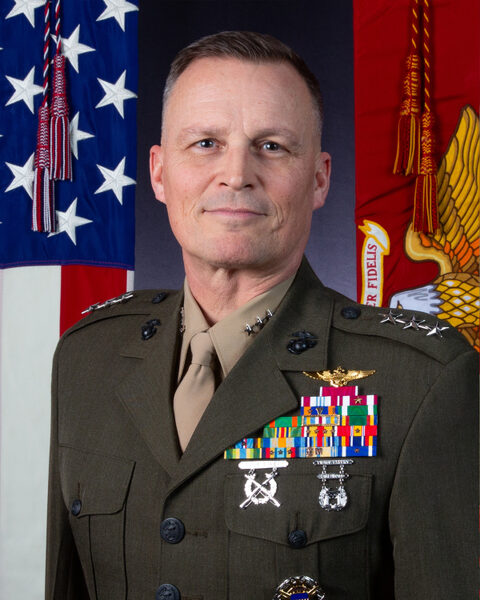
CommanderMarine Forces Reserve/Marine Forces SouthLieutenant General Len “Loni” Anderson was commissioned in 1993 upon graduation from the Illinois Institute of Technology. He was designated a naval aviator in October of 1995 and selected to fly the F/A-18 Hornet.
Lieutenant General Anderson's previous assignments as a General Officer include Assistant Deputy Commandant, Plans, Policies & Operations, Commanding General, 4th Marine Aircraft Wing, Deputy Commanding General, Marine Corps Forces Cyberspace Command and Deputy Commander, Joint Task Force-ARES.
Assignments in the Operating Forces include: Schedules Officer, Assistant Operations Officer, Air Wing Landing Signal Officer, and Weapons and Tactics Instructor with the “Fabulous Checkerboards” of VMFA-312 while deployed on USS Enterprise and USS Truman during Operations SOUTHERN WATCH, DESERT FOX and DELIBERATE FORGE; and Training Officer, MAG-31. In 2006, he transferred to the Marine Forces Reserve where he has served as the Assistant Operations Officer, Marine Aviation Training Support Group-42; Operations Officer, VMFA-112; and Commanding Officer, MALS-41.
Assignments in the Supporting Establishment include: Demonstration Pilot, Navy Flight Demonstration Squadron; Flight Instructor, VT-86; Operations Officer, Marine Aviation Training Support Group-42.
Headquarters and Staff Assignments: Senior Reserve Advisor, MAG-41; Reserve Branch Head, HQMC Aviation; Assistant Wing Commander, 4th Marine Aircraft Wing.
Joint assignments include two deployments in support of Operation INHERENT RESOLVE as the Deputy Director, Combined Joint Operations Center-Baghdad, Iraq and Battle Director, 609th Combined Air Operations Center, Qatar.
Lieutenant General Anderson is a graduate of the Weapons and Tactics Instructor Course, the Navy Fighter Weapons School (TOPGUN), Command and Staff College (DEP), Air War College (DEP), Advanced Joint PME, Senior Joint Information Operations Application Course, Harvard Kennedy School's Cybersecurity: The Intersection of Policy and Technology, Combined Force Air Component Commander Course, Leadership at the Peak, Syracuse University Maxwell School of Citizenship and Public Affairs National Security Management Course, U.S. Naval War College Advanced Flag and Senior Executive Course, and Johns Hopkins University Leading Data and AI-Enabled Organizations: For Senior Leaders.
He was promoted to his current rank and assumed duties as Commander, Marine Forces Reserve and Marine Forces South on 21 March 2024.
The Unfair Advantage: Mobilizing Marine Corps Power
In an era of renewed great-power competition, the United States Marine Corps confronts the imperative to rapidly generate and sustain combat power on
…In an era of renewed great-power competition, the United States Marine Corps confronts the imperative to rapidly generate and sustain combat power on a scale not seen since the Korean War. The hard-won lesson of that conflict—that rapid post-war demo
…In an era of renewed great-power competition, the United States Marine Corps confronts the imperative to rapidly generate and sustain combat power on a scale not seen since the Korean War. The hard-won lesson of that conflict—that rapid post-war demobilization left America "woefully unprepared" for a peer fight—serves as a critical reminder of the stakes. This presentation argues that the Marine Corps' true asymmetric advantage lies not in techno
…In an era of renewed great-power competition, the United States Marine Corps confronts the imperative to rapidly generate and sustain combat power on a scale not seen since the Korean War. The hard-won lesson of that conflict—that rapid post-war demobilization left America "woefully unprepared" for a peer fight—serves as a critical reminder of the stakes. This presentation argues that the Marine Corps' true asymmetric advantage lies not in technology alone, but in its strategic depth: a "deep bench" of lethality and experience across the Active and Reserve Components, including the often-underestimated Individual Ready Reserve (IRR).
Drawing from historical analysis of the pivotal 1950 mobilization, where reservists were essential for the Inchon landing, this session examines how a modernized approach to the Total Force can provide an unfair advantage over adversaries. By leveraging new directives and legal authorities, the Marine Corps can transform mobilization from a reactive process into a proactive weapon. This involves a deliberate strategy to continuously screen, train, and equip the entire reserve force, ensuring that specialized, combat-credible Marines from the IRR and other reserve statuses can be activated and deployed in weeks, not months.
The presentation will detail a framework for how this revitalized "deep bench", rich with both military experience and critical civilian skills, provides commanders with unparalleled flexibility and timeliness. By treating our reserve not as a force of last resort but as an integral component of our warfighting capability, the Marine Corps can ensure it will never again be caught unprepared, wielding its mobilized power as a decisive weapon to deter and, if necessary, dominate any future conflict.
Show MoreClick the title to see all detailsShow More