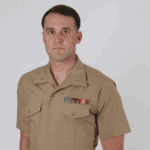

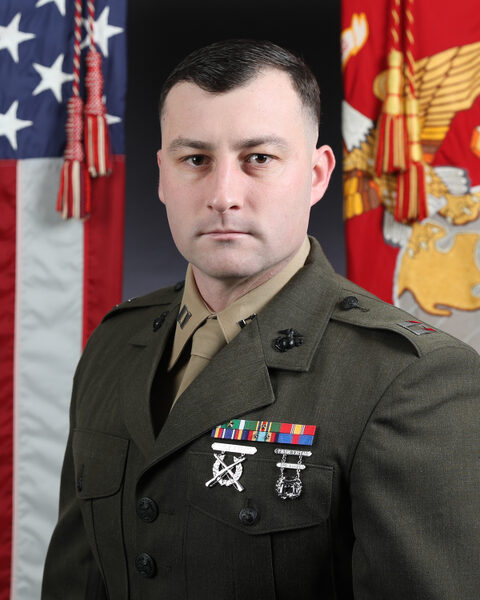
Capt Dominick Tranfaglia
Student, Expeditionary Warfare SchoolUnited States Marine Corps, Marine Corps UniversityCaptain Dominick Tranfaglia commissioned as a Second Lieutenant through the Platoon Leaders Class program in July 2018 and reported to The Basic School in September of that same year. Upon graduation from the Basic School, he reported to the Supply Chain Management Officer’s Course at Camp Johnson, North Carolina, where he graduated in September 2019 as a 3002 Ground Supply Officer.
Following MOS qualification, Captain Tranfaglia received orders to Headquarters Battalion, 3d Marine Division, Okinawa, Japan, where he served as the Headquarters Battalion Supply Officer from May 2019 to March 2022, filling an operational O-3 billet. During this assignment, he supported joint-level planning, serving as the Assistant Operations Officer (J3A) during exercise Cobra Gold 2021.
In March 2022, Captain Tranfaglia reported to Recruiting Station Denver, 9th Marine Corps District, where he served as the Operations Officer from March 2022 to March 2023. In April 2023, he assumed duties as the Officer Selection Officer in Fort Collins, Colorado, where he served until July 2025, overseeing officer accessions and leading officer recruiting efforts across his assigned area. In July 2025, Captain Tranfaglia reported to the Marine Corps University at Quantico, Virginia, where he is currently a student at the Expeditionary Warfare School.
His personal decorations include the Navy and Marine Corps Commendation Medal with a gold star.
USMC and the use of Artificial Intelligence Predictive Demand Planning in a Contested Information Environment
This paper argues that we must integrate artificial intelligence into predictive demand planning if we are to remain competitive in contested informat
…This paper argues that we must integrate artificial intelligence into predictive demand planning if we are to remain competitive in contested information environments, particularly against adversaries already leveraging AI-enabled logistics. Commerci
…This paper argues that we must integrate artificial intelligence into predictive demand planning if we are to remain competitive in contested information environments, particularly against adversaries already leveraging AI-enabled logistics. Commercial firms such as Amazon and FedEx demonstrate how AI-driven forecasting, simulation modeling, and large language models can optimize inventory placement, anticipate demand,a nd accelerate decision-mak
…This paper argues that we must integrate artificial intelligence into predictive demand planning if we are to remain competitive in contested information environments, particularly against adversaries already leveraging AI-enabled logistics. Commercial firms such as Amazon and FedEx demonstrate how AI-driven forecasting, simulation modeling, and large language models can optimize inventory placement, anticipate demand,a nd accelerate decision-making. By contrast, we continue to rely on fragmented data systems, static planning methods, and limited interoperability, which slow throughput and increase risk in high-tempo, and dispersed operations. Without secure integration of predictive analytics int our command-and-control systems, we risk delayed resupply, maintenance shortfalls, and exploitable logistical vulnerabilities - especially in theaters like INDOPACOM where distance, dispersion, and adversary anti-access capabilities compound sustainment challenges. To address this gap, we propose three complementary courses of action: AI-enbaled predictive logistics for maintenance and demand forecasting, AI-optimized contested distribution routing, and AI-prioritized additve manufacturing. Predictive models would allow us to anticipate equipment failures and supply requirements before they occur, reducing downtime and emergency resupply. AI-driven routing tools would enhance survivability by optimizing movement across contested domains based on ISR patterns, weather, and platform availability. Finally, additive manufacturing, guided by AI to prioritize mission critical parts, would reduce our reliance on vulnerable supply lines. Together, these solutions provide a phased, practical path to transforming our logistics enterprise from a reactive support function into a resilient, data-driven combat advantage.
Show MoreClick the title to see all detailsShow More