
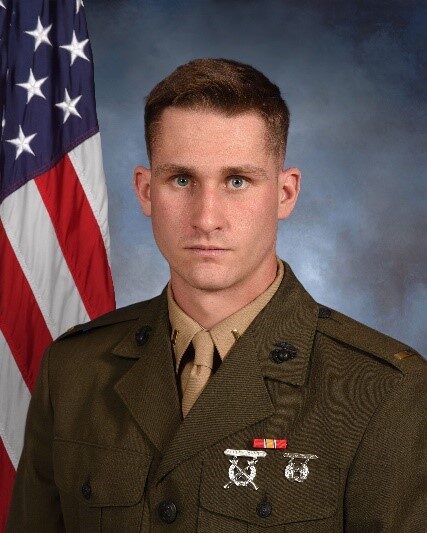
Capt Daniel O’Brien
EWS StudentEWS / MCUCapt Dan O’Brien is a native of Dallas, Texas, and commissioned in the Marine Corps in June 2021. In 2022, he joined 2d Radio Battalion, where he served as a Platoon Commander, Current Operations Officer, and Assistant Operations Officer. Capt O’Brien’s Operations Deployments include ASSURE AND DETER 24.2, where he served as the Detachment OIC, Information Warfare Operations Officer, and SIGINT advisor to Commander, Task Force SIX SIX.
His Professional military education includes: The Basic School, Tactical Intelligence Officer Course, Signals Intelligence Officer Course, SERE, and the Expeditionary Warfare School. Capt O’Brien earned a Bachelor of Arts in Political Science, Economics, and Russian from the University of Notre Dame and is currently pursuing a Master of Science of Strategic Intelligence from National Intelligence University. Capt O’Brien is married to Ana Miravete.
A Hitchhiker’s Guide to RxR in the WEZ
In future conflict, the first casualty will not be maneuver forces, logistics nodes, or command posts; it will be certainty. As the character of warfa
…In future conflict, the first casualty will not be maneuver forces, logistics nodes, or command posts; it will be certainty. As the character of warfare shifts from counterinsurgency to competition with near-peer adversaries, the United States Marine
…In future conflict, the first casualty will not be maneuver forces, logistics nodes, or command posts; it will be certainty. As the character of warfare shifts from counterinsurgency to competition with near-peer adversaries, the United States Marine Corps faces an operational environment defined by degraded sensing, contested communications, and persistent adversary reconnaissance. Nowhere is this challenge more severe than for reconnaissance fo
…In future conflict, the first casualty will not be maneuver forces, logistics nodes, or command posts; it will be certainty. As the character of warfare shifts from counterinsurgency to competition with near-peer adversaries, the United States Marine Corps faces an operational environment defined by degraded sensing, contested communications, and persistent adversary reconnaissance. Nowhere is this challenge more severe than for reconnaissance forces operating as Stand-in Forces (SIF) inside a sophisticated anti-access/area denial (A2/AD) bubble. The Marine Corps Intelligence, Surveillance, and Reconnaissance Enterprise (MCISRE), long optimized for permissive environments and centralized intelligence architectures, must adapt to a battlespace where detection is constant and survivability fleeting. By examining the limitations of current ISR constructs, assessing adversary counter-reconnaissance capabilities, and drawing lessons from historical case studies such as the Yom Kippur War, we analyze how artificial intelligence (AI) and disruptive technologies are not merely force multipliers, but prerequisites for effective reconnaissance and counter-reconnaissance in competition-to-conflict scenarios. We argues that the MCISRE should leverage low-cost, unmanned, commercial-off-the-shelf (COTS) systems paired with AI-enabled autonomy to support distributed collections and tactical deception, regain the information advantage, persist within the weapons engagement zone (WEZ), and shape the battlespace in support of joint and naval operations.
Show MoreClick the title to see all detailsShow More