
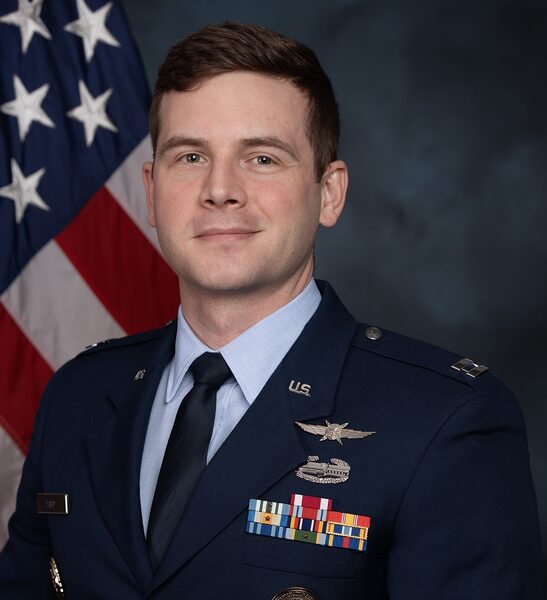
Capt Aubrey Sapp
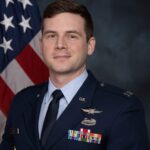
StudentExpeditionary Warfare SchoolCaptain Aubrey M. Sapp is currently a student at Expeditionary Warfare School (EWS), Marine Corps University, Quantico, VA. Prior to attending EWS, Captain Sapp served as Branch Chief, J35 Future Systems at the White House Communications Agency where he led mission planning and oversaw the development and integration of new mission systems and solutions, to include related tactics, techniques, procedures, and policies in order to ensure the President and Vice President could communicate anytime, anywhere, and under any condition. Captain Sapp also served as a White House Military Office Lead, deploying globally to support the President and Vice President on White House travel missions.
Captain Sapp entered the Air Force in May 2018, earning his commission through ROTC at the University of Florida, where he obtained a Bachelor of Science degree in Computer Science. After commissioning, he attended Undergraduate Cyber Training at Keesler Air Force Base, MS, graduating in June of 2019. Since then, Capt Sapp has served in a variety of roles related to employment and development of expeditionary communications systems, particularly within USSOCOM, specializing in Special Communications, Electronic Warfare, and Technical Operations. Capt Sapp has deployed to Iraq and Syria in support of Operation INHERENT RESOLVE and joint counterterrorism operations.
A Hitchhiker’s Guide to RxR in the WEZ
In future conflict, the first casualty will not be maneuver forces, logistics nodes, or command posts; it will be certainty. As the character of warfa
…In future conflict, the first casualty will not be maneuver forces, logistics nodes, or command posts; it will be certainty. As the character of warfare shifts from counterinsurgency to competition with near-peer adversaries, the United States Marine
…In future conflict, the first casualty will not be maneuver forces, logistics nodes, or command posts; it will be certainty. As the character of warfare shifts from counterinsurgency to competition with near-peer adversaries, the United States Marine Corps faces an operational environment defined by degraded sensing, contested communications, and persistent adversary reconnaissance. Nowhere is this challenge more severe than for reconnaissance fo
…In future conflict, the first casualty will not be maneuver forces, logistics nodes, or command posts; it will be certainty. As the character of warfare shifts from counterinsurgency to competition with near-peer adversaries, the United States Marine Corps faces an operational environment defined by degraded sensing, contested communications, and persistent adversary reconnaissance. Nowhere is this challenge more severe than for reconnaissance forces operating as Stand-in Forces (SIF) inside a sophisticated anti-access/area denial (A2/AD) bubble. The Marine Corps Intelligence, Surveillance, and Reconnaissance Enterprise (MCISRE), long optimized for permissive environments and centralized intelligence architectures, must adapt to a battlespace where detection is constant and survivability fleeting. By examining the limitations of current ISR constructs, assessing adversary counter-reconnaissance capabilities, and drawing lessons from historical case studies such as the Yom Kippur War, we analyze how artificial intelligence (AI) and disruptive technologies are not merely force multipliers, but prerequisites for effective reconnaissance and counter-reconnaissance in competition-to-conflict scenarios. We argues that the MCISRE should leverage low-cost, unmanned, commercial-off-the-shelf (COTS) systems paired with AI-enabled autonomy to support distributed collections and tactical deception, regain the information advantage, persist within the weapons engagement zone (WEZ), and shape the battlespace in support of joint and naval operations.
Show MoreClick the title to see all detailsShow More